Since 2022, with the additional exhibition space that became available with the opening of Vladem Contemporary, the New Mexico Museum of Art has dedicated a distinct space to showcasing highlights from its 20th Century Collection to ensure that works by the region’s most iconic artists will always be available to visitors.
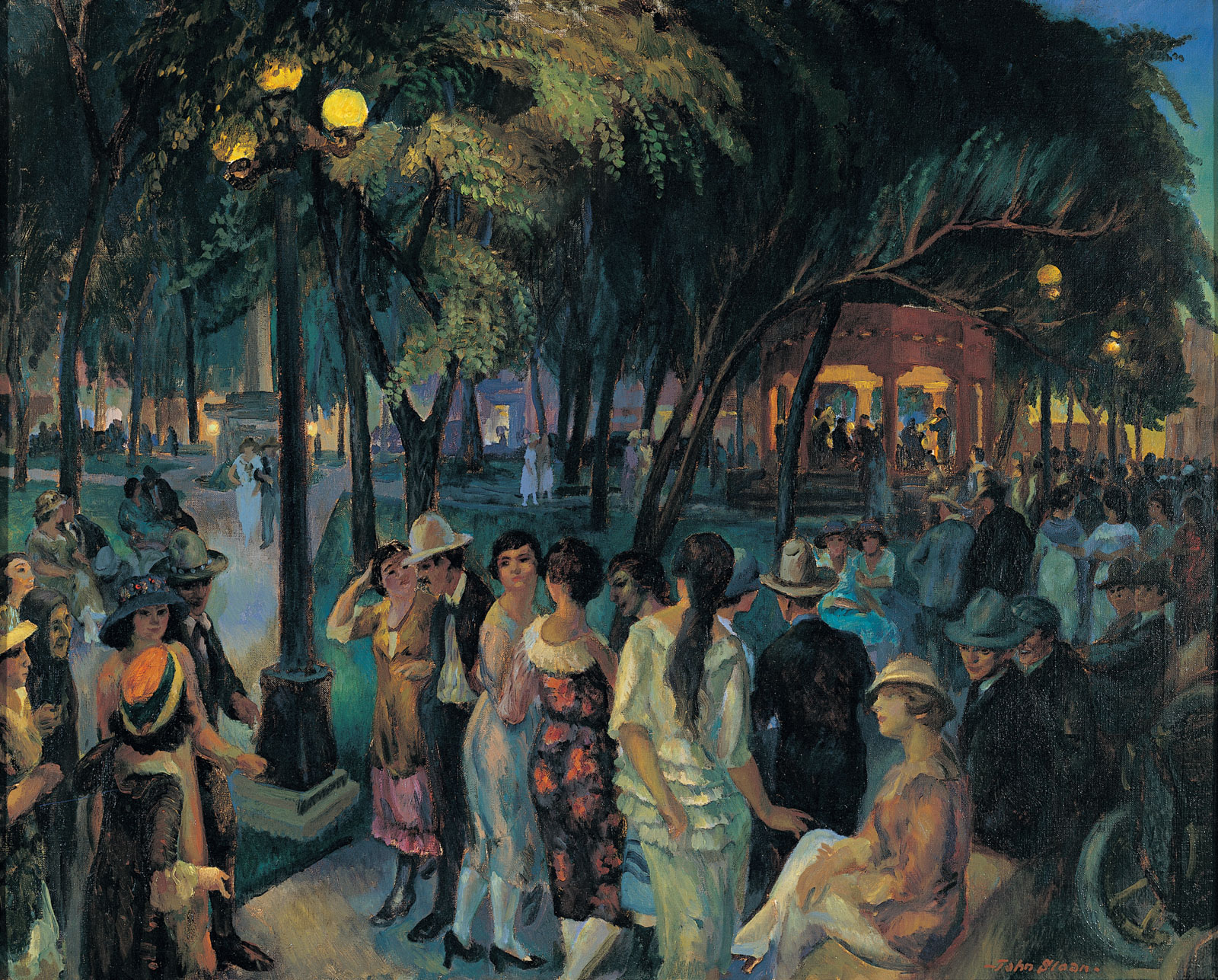
John Sloan (1871-1951), Music in the Plaza (Plaza, Evening, Santa Fe), 1920. Oil on canvas, 26 x 32 in. Collection of the New Mexico Museum of Art. Gift of Mrs. Cyrus McCormick, 1952 (326.23P). Photo by Blair Clark.
On view in the current iteration of the rotating exhibition are works by foundational Santa Fe artists Gerald Cassidy, Robert Henri, Luis Crow, Maria Martinez, B.J.O. Nordfeldt, John Sloan, Gustave Baumann and William Penhallow Henderson, and others. Also on view are paintings by members of the Taos Society of Artists, Los Cinco Pintores and Santa Fe Bohemians; as well as significant American Modernists including Georgia O’Keeffe, Marsden Hartley and Andrew Dasburg; and Transcendentalist Agnes Pelton.
Other notable artists in the collection are early Hispano modernists Patrociño Barela and Esquípula Romero de Romero; and realists Henriette Wyeth and Peter Hurd from the southern part of the state.
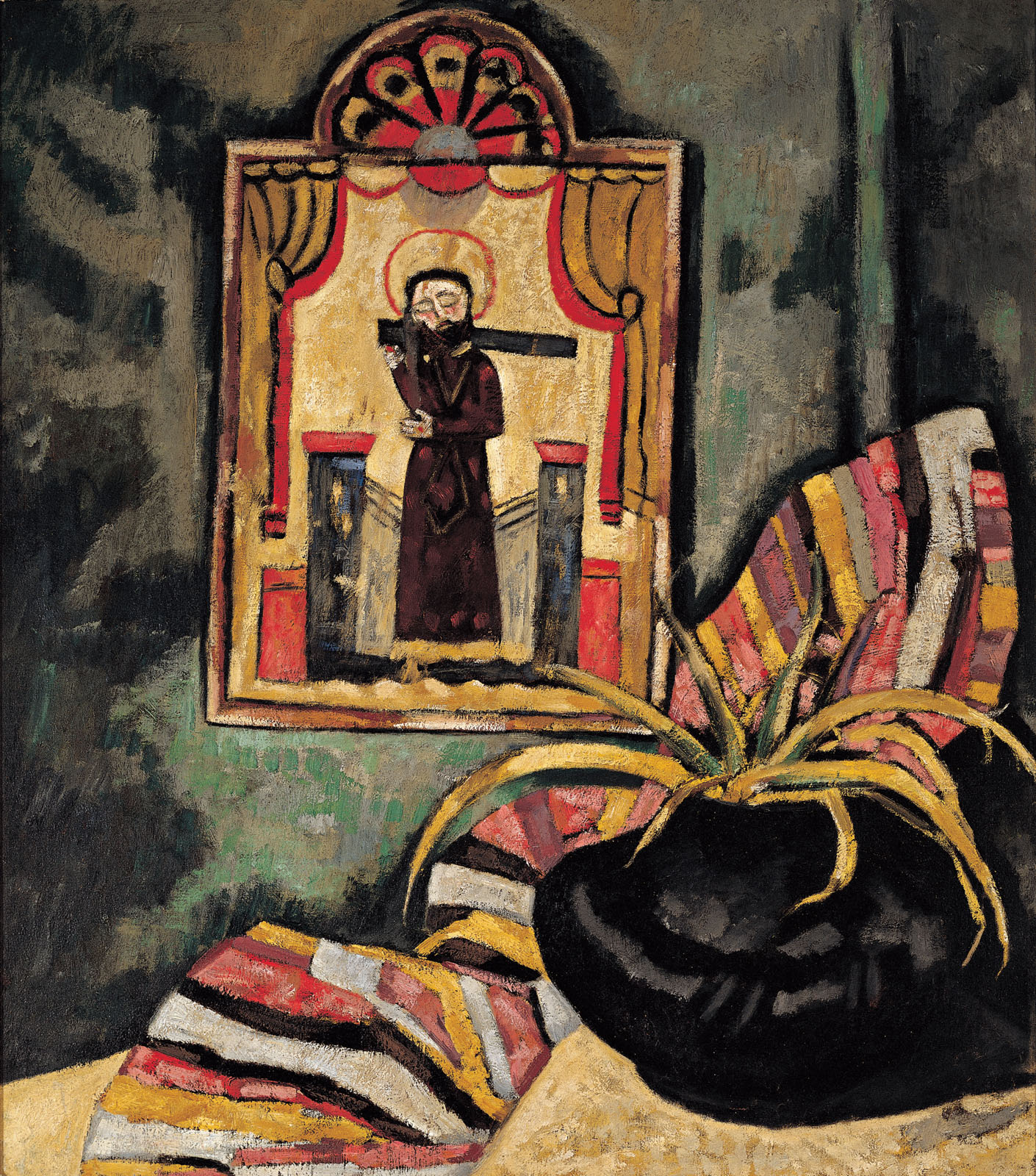
Marsden Hartley (1877-1943), El Santo, 1919. Oil on canvas, 36 x 32 in. Collection of the New Mexico Museum of Art. Anonymous gift from a friend of Southwest art, 1919 (523.23P). Photo by Blair Clark.
“This gallery features the most important and impactful works in our collection, and each artist present has made a significant contribution to the art history of New Mexico and the United States,” says the museum’s head of curatorial affairs and curator of 20th-century art Christian Waguespack. “That said, some of the standouts include John Sloan, Marsden Hartley, Georgia O’Keeffe and Agnes Pelton.
“John Sloan first visited New Mexico in 1919 at the behest of Robert Henri and, over the next 30 years, Sloan visited New Mexico regularly, primarily painting genre scenes of community life, including Native ceremonies, and secular scenes like Music in the Plaza,” Waguespack continues. “In the 1920s, Santa Fe began holding community cultural events centered on the historic Plaza. Sloan, who enjoyed being a spectator of modern life, inserted himself in the lower right of the composition with his family present in the lower left. The museum appears at the right edge of the canvas against the setting sun.”
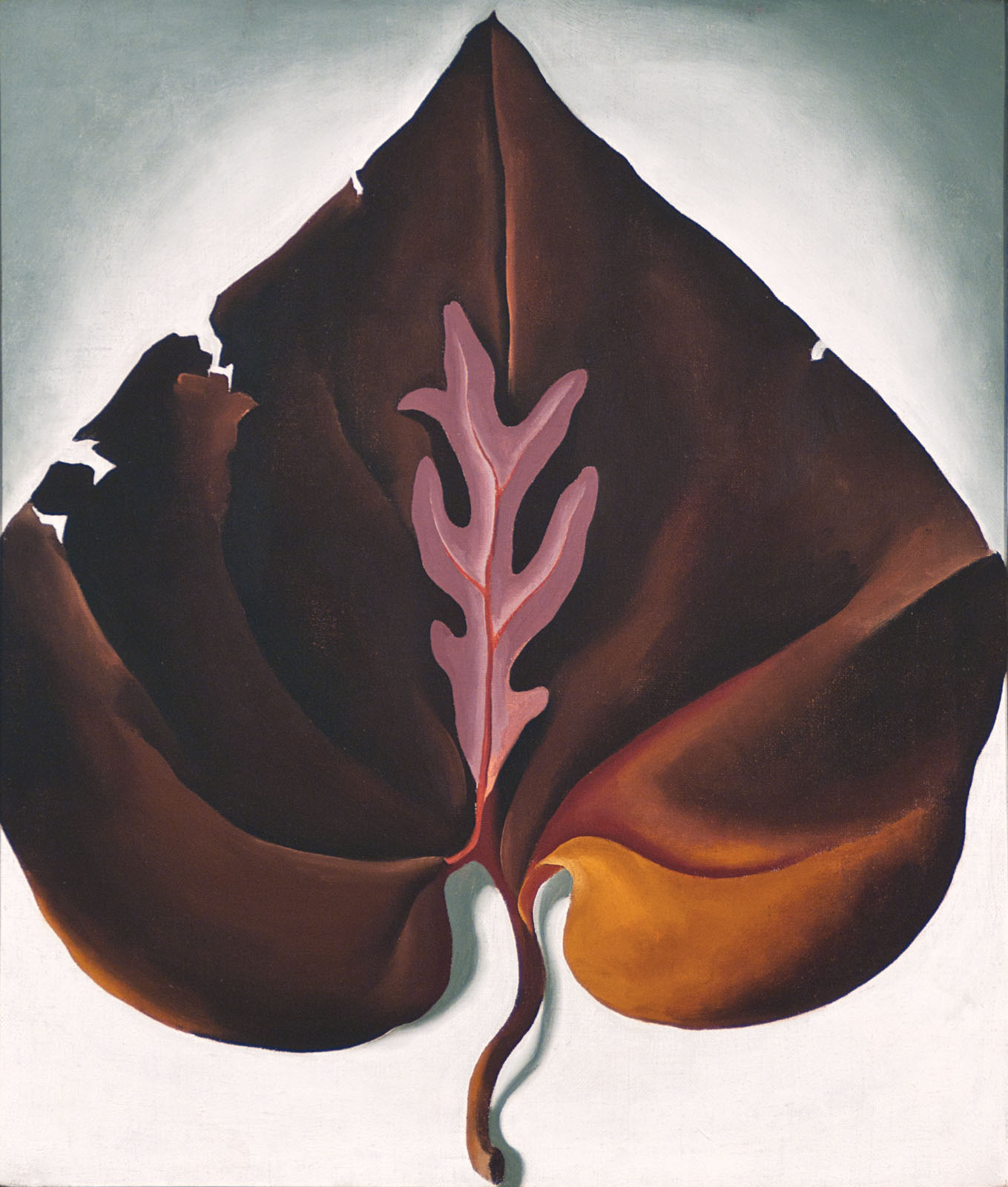
Georgia O’Keeffe (1887-1986), Dark and Lavender Leaves, 1931. Oil on canvas, 19¾ x 169⁄16 in. Collection of the New Mexico Museum of Art. Gift of the Georgia O’Keeffe Estate, 1993 (1993.51.3). © New Mexico Museum of Art. Photo by Blair Clark
Always in search of distinctly American subject matter, Hartley found that in New Mexico in the blending of Native, Hispanic and Euro-American cultures, as seen in his painting El Santo which incorporates imagery associated with Hispanic Catholicism with Indigenous pottery and textiles, objects he deemed worthy of emulation.
In 1938, Pelton founded the Transcendental Painting Group, a collective of New Mexican artists whose work addressed spiritual and metaphysical themes. She is represented though her painting Awakening (Memory of Father). “Pelton wrote in her journals that the yellow celestial form represents Gabriel’s trumpet,” explains Waguespack. “The contours of the mountain peaks in the landscape from the silhouette of her father’s profile. A complicated figure in Pelton’s life, her father deserted her and her mother in childhood, later dying of a morphine overdose.”
Of course, no New Mexico exhibition would be complete with out at least one Georgia O’Keeffe painting. The museum has 15 in their holdings, with two featured in the current display, including Dark and Lavender Leaves from 1931, an example of her near-abstract, blown-up and close-cropped natural forms, and signature smooth surfaces and rich color.
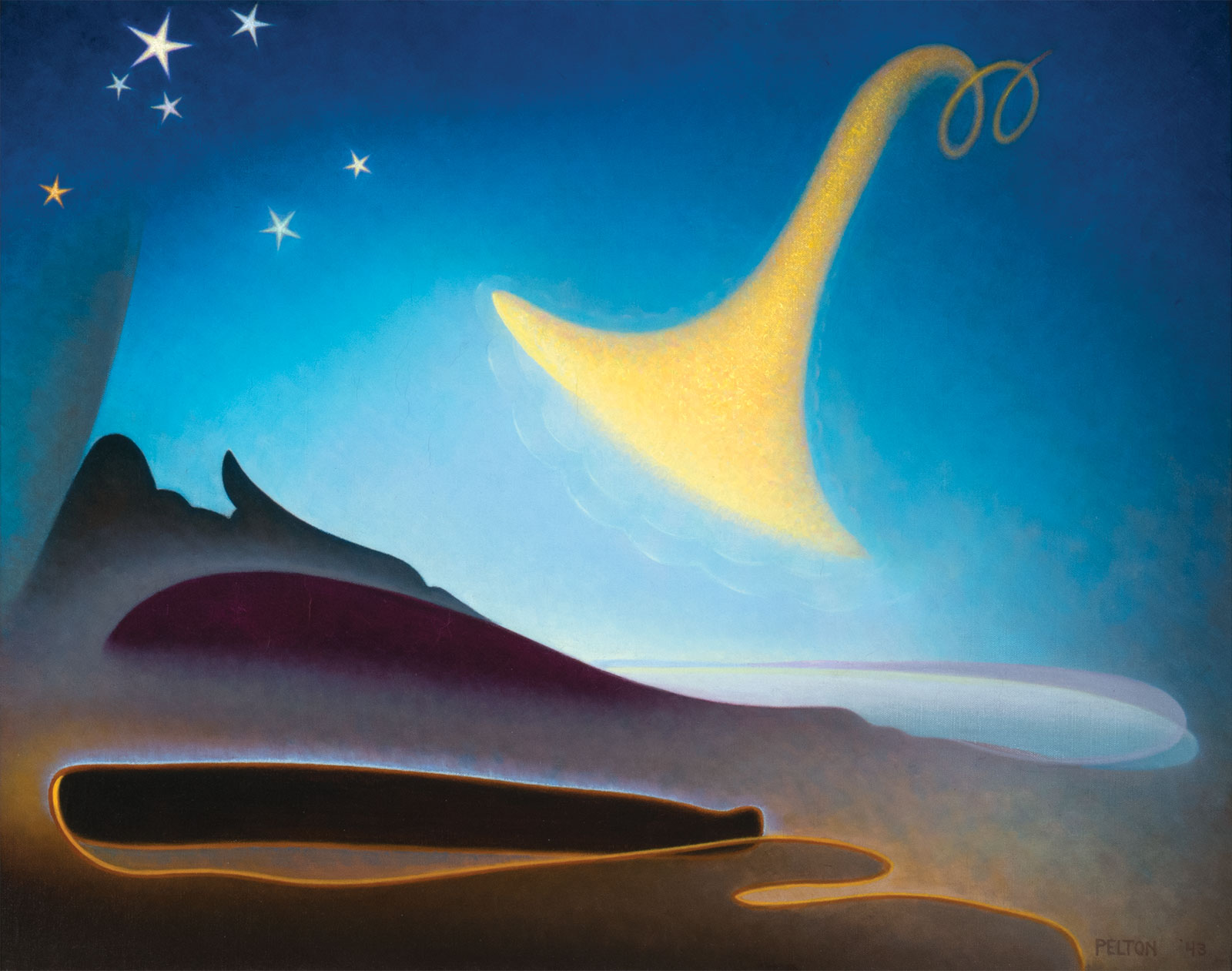
Agnes Pelton (1881-1961), Awakening (Memory of Father), 1943, oil on canvas, 22 x 28 in. Collection of the New Mexico Museum of Art. Museum purchase, 2005 (2005.27.1). Photo by Blair Clark.
“The artwork on display in this gallery if a reflection of the major artistic and social issues at the heart of the early 20th century in New Mexico,” says Waguespack. Works like Gerald Cassidy’s Qui Bono address issues of cultural preservation and indigenous assimilation in the face of statehood, and works by the Taos Society also celebrate indigenous culture. Both the Taos Society artists and modernists like Hartley reflect how people at that time were looking West to a distinctive American identity that was on par with the cultural power house of Europe, and the modernists reflect the most avant-garde approaches to art at the time.”
Powered by Froala Editor